Jump to a section 5 sections
Understand the idea
A harmonica is small enough to fit in a pocket, but learning to play it involves more than blowing into the nearest hole. Lessons help you find clean notes, control the sound and put a short musical phrase together. You may be drawn to blues, folk melodies, popular tunes or the sound of a chromatic harmonica. Those interests affect which instrument and teacher will suit you. Before buying one, ask the tutor exactly which type and key their beginner course uses. A clearly matched starting instrument makes following demonstrations much easier than arriving with a harmonica chosen only by appearance.
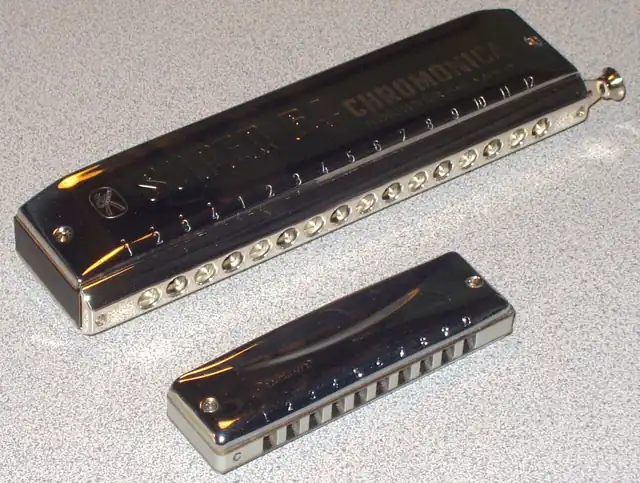
Match the harmonica to the lesson
Diatonic and chromatic harmonicas are different instruments to learn, even though both belong to the same family. A class may also specify a particular key so that everyone can play together. Do not assume a harmonica inherited from a relative or bought as a souvenir will match the course. Tell the teacher any writing on its case and body, and ask for help identifying it. If an instrument is included in the booking, check what it is and whether you keep it. A clear answer avoids spending the first lesson unable to follow the examples.
Look for a careful beginning
An introductory lesson can spend useful time on holding the instrument, finding one note and moving to another without accidentally sounding several holes. The tutor can hear details that are hard to judge while you play. They may demonstrate different mouth positions and help you discover what gives a consistent sound. Advanced effects are appealing, but a course that promises them immediately may be frustrating if the basic notes are still uncertain. Ask what a first lesson covers and what an achievable practice task looks like. A short recognisable melody can be a worthwhile early goal.
Choose the music as well as the teacher
A blues workshop may use short call-and-response phrases and work towards playing with a backing track. Another class might teach folk tunes or reading melodies, while chromatic lessons can take a different route again. Listen to the teacher's examples and ask what music beginners actually use. You do not need to copy the tutor's whole musical taste, but the repertoire should give you a reason to practise. If you want to play alongside a guitarist or singer, mention that early. Learning alone and preparing to join other musicians can call for different exercises.
Plan for your own instrument
Because a harmonica is played directly at the mouth, ask about hygiene arrangements before any taster that supplies instruments. Prefer a clearly explained personal instrument arrangement, and follow the manufacturer's care guidance for your particular model. Do not assume an instrument can be soaked or taken apart safely because a different type can. Bring a case so it stays protected in a bag. For ongoing classes, keep the same suitable instrument available for practice. A private tutor may be useful when you need more individual demonstration time than a mixed group can offer.
Build a practice routine you can hear
Take away a small task: two clear notes, a short phrase or a simple rhythm. Record a brief personal practice sample if that helps you notice whether the sound is becoming more consistent. Ask the teacher which details to listen for so that recording has a purpose. Repeating the same difficult passage quickly is often less useful than breaking it into smaller parts at an easy pace. Search again by instrument type or musical style if a general query brings up unrelated music lessons. Also check whether a workshop is truly for first-time players or expects existing skills.
You might also like to explore
Music school
Music schools can offer instrument lessons, singing, theory and ensemble playing.
Music store
Music and record shops can be places to discover unfamiliar artists as well as buy a specific release.
Courses
Short courses can be a low-commitment way to discover a new interest, but the course title should translate into specific learning outcomes.
Open a guide to see what it involves and find a more specific search.
Sources and further reading
Further reading for the subjects discussed in this guide. Provider arrangements and local availability should be checked separately.